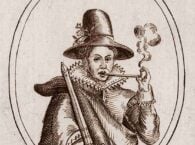
 If you have the time, I have a few pipe and tobacco stories to pass along. And I promise that they are mostly true as far as I can tell. For those of you who are First Responders members, this first story will sound familiar because it was recently told in one of my weekly First Responders newsletters. This first picture is an artistic drawing of perhaps the world’s first famous lady pipe smoker. Her name was Mary Frith. She was born in London, England way back in 1584, and lived quite the rogue’s life until her death in 1659 at the age of 75. After looking over her profile on Wikipedia, I quickly discovered that she was no role model. In fact, she was known as a thief, pickpocket and fence who gained quite the reputation of being very talented at all three of those occupations. She was also known for her constant swearing and being the only woman of that day who would boldly smoke her pipe in public. Her thievery of purses and other items caused her to be punished by having her hands burned on four separate occasions, a common punishment back in those days for thieves. To add to Frith’s resume, she also worked as a pimp. She not only procured young women for men, but also respectable male lovers for middle-class wives. So there you have it, the story of the world’s first famous lady pipe smoker. And by the way, I never could find out what type of pipe or blend of tobacco she preferred.
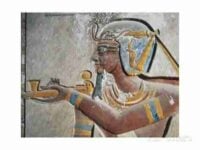 Who actually invented pipes for smoking? Well, according to Google, The first smoking pipes were found in Egypt and dated back to 2000 BC; they were made of copper and found inside tombs alongside mummies and were put there so that those mummies could enjoy a smoke in the afterlife! However, historians are unsure whether the Egyptians used the pipes for religious rituals or recreational use. Drawings on the inside of Egyptian pyramid walls depict Egyptians smoking their copper pipes, and the artwork was etched with a variety of soft colored rocks. I could find no information about the kinds of tobaccos that were smoked back in 2000 BC, but I sure have smoked some pipe tobacco blends over the years that I think should be locked up in those old pyramids!
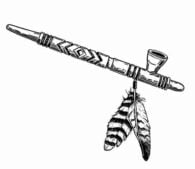 Tobacco as we know it today, and the culture that surrounds it, come from America. Over 500 years ago, American-Indians grew and harvested a typle of plant that is a member of the Burley family. The smoking of these plants was first used for only medicinal reasons, but apparently, they figured out that it was just plain tasty to smoke for enjoyment, too. They rolled up the tobacco leaves in the shape of a large cigar that they called ‘tabaco’. They burned these tobacco leaves, along with the other herbs, in their famous tobacco pipes, which we now know as peace pipes and there are a lot of pipe makers today who make similar shaped pipes and are called the ‘calumet’.
 Every once in awhile, I spot yet another article in the paper regarding the hazards of smoking tobacco. That’s so annoying. So for this blog, I decided to look up some fun, and yes, even some rather weird facts regarding tobacco that we just don’t find in the local rags around the country (or anywhere else for that matter.) Below are some of the jewels I found while grabbing my computer and jumping into cyber space. These researched facts that I found were written by a lady named Karin Lehnardt back in 2016 for a website called FactRetreiver. And kudos to Ms. Lehnardt for digging up facts about tobacco that I, for one, had never heard of. Here we go:
- Sir Walter Raleigh took his pipe with him to the scaffold when he was beheaded in 1618.
- In ancient America, tobacco was chewed, drunk as tea, inhaled as a powder-like snuff, and consumed as a jelly—but smoking tobacco was by far the most popular.
- The Peruvian Aguaruna aboriginals would make hallucinogenic enemas using tobacco.
- Smoking tobacco was thought to cure syphilis in the mid-sixteenth century in Europe.
- Both in ancient America and in sixteenth-century Europe, “holy smoke” from tobacco was thought to help cure illnesses and drive out evil spirits.
- Urea, a chemical compound found in urine is added to cigarette tobacco for extra flavor.
- Renaissance author Ben Jonson argued that smoking was the “devil’s fart.
- Women in the United States increasingly began smoking publicly in the 1920s when the cigarette was adopted by advertisers as a symbol of equality, rebellion, and women’s independence.
- The Aztecs regarded tobacco as the incarnation of the goddess Cihuacoatl, whose body, they believed, was composed of tobacco. Tobacco gourds and pouches were seen as symbols of divinity.
- Ambergris (whale vomit) has been added to snuff for flavor.
- According to Alfred Dunhill, Africans have had a long tradition of smoking hemp in gourd pipes, asserting that by 1884 the King of the Baluka tribe of the Congo had established a “riamba” or hemp-smoking cult in place of fetish-worship. Enormous gourd pipes were used.
- Tobacco became famous in Europe after Christopher Columbus discovered the Americas. Once he saw that the Native American people were using it for medicinal purposes and to smoke out of pipes, he took it back to Spain with him.
- And finally, Nicotine is named after Jean Nicot, the French ambassador to Portugal who brought tobacco and smoking to the French court in the mid-sixteenth century as a medicine.
 So what are taste buds and how do they relate to the way pipe smokers enjoy their tobacco? Taste buds are fairly complicated little suckers. They are tiny, yet are made up of all kinds of things like Gustatory Hair, Basal Cells, Cranial Nerve Fibers, Filiform Papilla and Fungiform Papilla within their tiny little bodies, and all participate in how we taste food, drink, and of course, our pipe tobacco!
When you and I talk about the “taste” of our tobacco, we tend to generalize by saying a blend tastes mild or strong, sweet or bitter, figgy, grassy, spicy, smoky, heavy, etc. And of course, with great tobacco blends, we get a bundle of different sensations. And actually, it’s not only the qualities of taste perceived by the tongue, but also the smell. That’s right, to taste your tobacco fully, your snout needs to get in on the action. Did you know that only after taste is combined with smell, is a pipe tobacco’s flavor presentation fully appreciated? If the sense of smell is impaired, by a stuffy nose for instance, perception of taste is usually dulled as well.
I remember back when I was just a kid (yes, a very long time ago), my mom used to tell me to be sure to brush my tongue as well as my teeth to keep my taste buds clean so that I could taste my food. I was always horrified at the thought of not tasting cookies or cake, so I made sure to brush my waggler really good if I knew that I was getting a goodie after supper. And of course, I didn’t brush all day if I knew that Brussels Sprouts were on the dinner menu. So, if you really want to capture all of the nuances of the tobacco that you are smoking, brush your tongue first and keep your nose clean!
Happy Puffing,
Steve
